If you learned to program after ~2005, you missed the free lunch. For three decades, single-threaded code got faster no matter what you did — you just waited for the next chip. That era ended not because one law ran out, but because two laws that had been compounding together stopped agreeing.
Two laws in partnership
Moore's first lawMoore's first law
summary:
The number of transistors in a dense integrated circuit (IC) doubles about every two years (1965)
~ Co-founder of Intel Corporation
[[Gordon Moore's original graph::lmn]]
reference
... promised more transistors every two years. But transistor count alone doesn't make a chip faster — the second half of the partnership was Dennard LawDennard Law
as transistors get smaller, their power density stays constant, so that the power use stays in proportion with area; both voltageand current scale (downward) with length. (1974)
: as transistors shrink, their power density stays constant, because voltage and current scale down along with length. Transclusion
Dennard Law
Together they were a printing press for performance: each process node gave you more transistors and a flat power budget, so architects spent the surplus on clock speed. Processors went from megahertz to 3–4 GHz in roughly thirty years, and code compiled for a 1995 CPU ran visibly faster on every new machine you bought.
The wall, around 2005
Dennard scaling broke first. Below ~90nm, supply voltage could no longer keep scaling down — leakage current grows as transistors shrink, and the physics of the transistor's switching threshold puts a floor under how far voltage can drop. Power density, flat for thirty years, started climbing with frequency again. Chips were one bad thermal design away from melting, and the industry quietly stopped racing on gigahertz. Clock speeds plateaued where they remain, for single-thread boost, to this day.
Moore's law kept shipping transistors, though. With frequency off the table, the surplus went somewhere else: more cores per socket. Herb Sutter's The Free Lunch Is Over (2005) is the field's memo about this pivot.
The multicore catch
More cores sounds like the same free lunch with extra steps. Transclusion
Amdahl's law
Amdahl's lawAmdahl's law
the overall performance improvement gained by optimizing a single part of a system is limited by the fraction of time that the improved part is actually used (1967)
Amdahl's law is often used in pa... says the serial fraction of your program caps the speedup, no matter how many cores you throw at it: speedup = 1 / ((1 - p) + p/n). If 5% of your work is serial, twenty-fold speedup is the ceiling — a thousand cores gets you no further. Amdahl's limit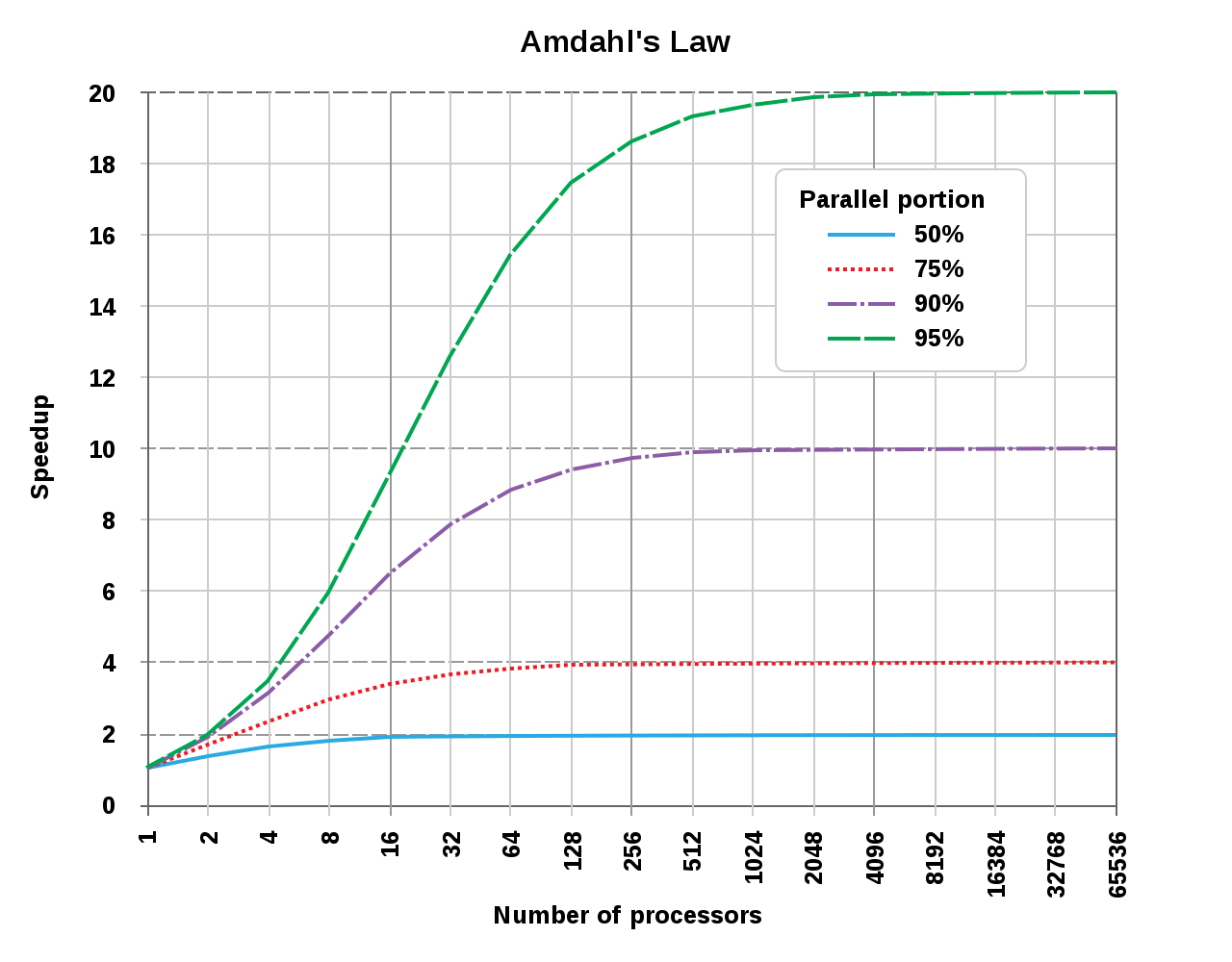
Gustafson's lawGustafson's law
gives the speedup in the execution time of a task that theoretically gains from parallel computing, using a hypothetical run of the task on a single-core machine as the baseline. To put it another ... pushed back in 1988: real programs don't have a fixed size. Give researchers more cores and they simulate bigger grids, not the same grid faster — so the useful metric is how much more work you can do, not how much faster the same work finishes. Both are right; they measure different ambitions. Parallelism turned out to be a way to grow workloads, not a free replacement for fast serial execution.
Where the transistors went instead
With clocks frozen, the architects' transistor budget went to making each clock do more — deeper caches, better branch predictors, out-of-order windows, and eventually whole accelerators: GPUs, NPUs, TPUs. Single-thread performance still improves, but it is engineers spending the transistor budget carefully, not physics handing it over for free. The term for the leftover transistors you can't afford to switch on at once — because of that same power wall — is "dark silicon".
The Jevons twist
Here is the part I find genuinely ironic. Jevons paradoxJevons paradox
In economics, the Jevons paradox (/sometimes Jevons effect) occurs when technological progress or government policy increases the efficiency with which a resource is used (reducing the amount neces... — from 1865 economics, about coal — says that making a resource cheaper to use increases total consumption of it. Computing is the textbook case: we made operations millions of times more efficient per watt, and total compute demand exploded to meet it. The industry that stopped making single cores faster now runs data centres that consume more power than entire countries.
Where this leaves Moore's law
Status of Moore's LawStatus of Moore's Law
Introduction
Semi-conductor industry has followed Moore's first lawMoore's first law
summary:
The number of transistors in a dense integrated circuit (IC) doubles about every two years (1965)
~ Co-founder of Intel Corporation
[[Gordon Moore's original graph::lmn]]
reference
... for more than half a century [[Cramming more components onto integrated circuits paper::lsn-transclude]]. He corrected the l... covers the endpoint of the other half: the roadmap bodies declared Moore's law over in 2015. With Dennard gone since 2005 and Moore winding down, the fifty-year compounding is finished on both fronts — which is exactly why the current era is one of specialisation (accelerators for matrix math, for crypto, for networking) and why so many bets (chiplets, 3D stacking, new substrates) are really attempts to re-import one more generation of "free" performance.
The seeds behind this post: Moore's first lawMoore's first law
summary:
The number of transistors in a dense integrated circuit (IC) doubles about every two years (1965)
~ Co-founder of Intel Corporation
[[Gordon Moore's original graph::lmn]]
reference
..., Dennard LawDennard Law
as transistors get smaller, their power density stays constant, so that the power use stays in proportion with area; both voltageand current scale (downward) with length. (1974)
, Amdahl's lawAmdahl's law
the overall performance improvement gained by optimizing a single part of a system is limited by the fraction of time that the improved part is actually used (1967)
Amdahl's law is often used in pa..., Gustafson's lawGustafson's law
gives the speedup in the execution time of a task that theoretically gains from parallel computing, using a hypothetical run of the task on a single-core machine as the baseline. To put it another ..., Jevons paradoxJevons paradox
In economics, the Jevons paradox (/sometimes Jevons effect) occurs when technological progress or government policy increases the efficiency with which a resource is used (reducing the amount neces....